
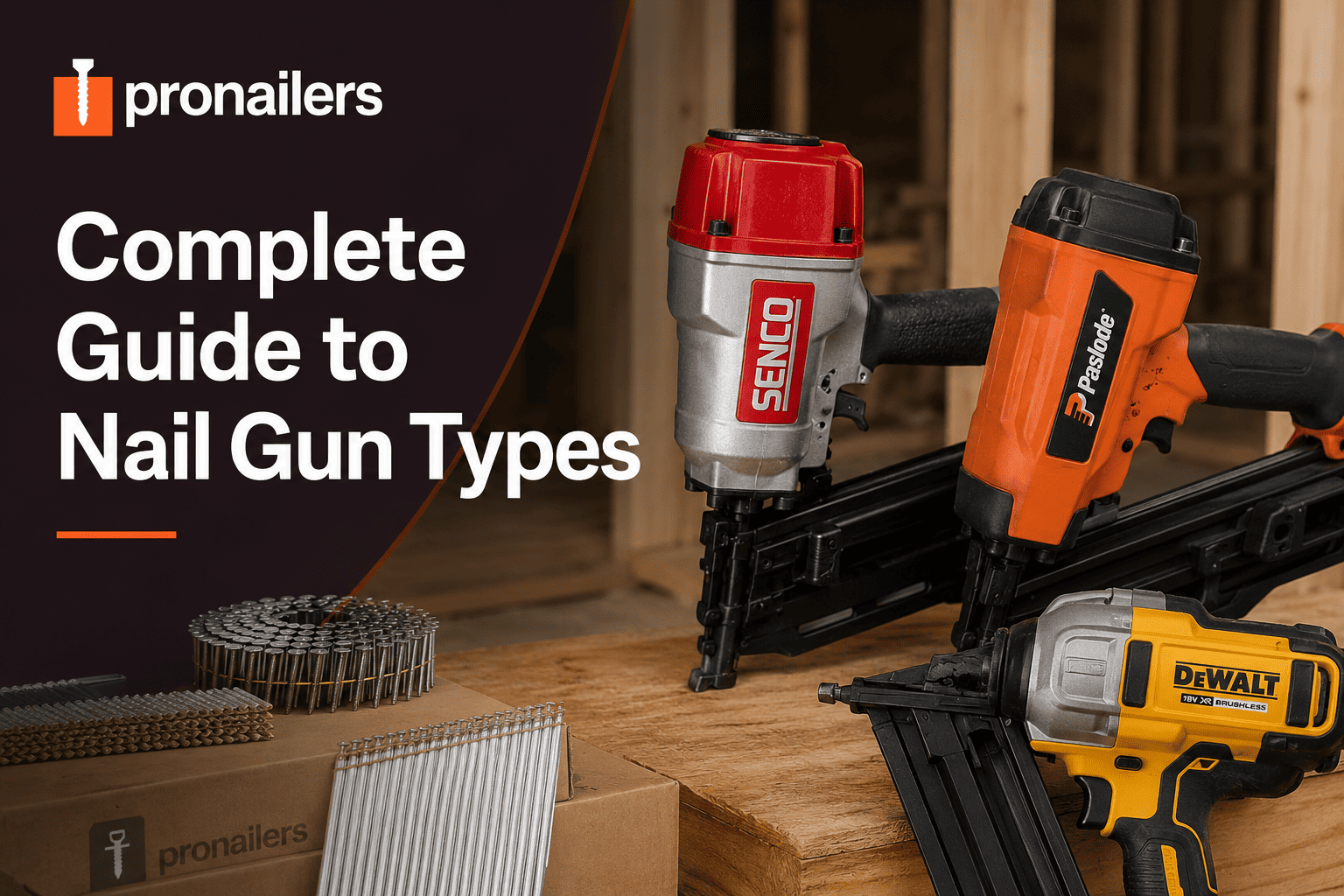
Key Points:
-
Nail guns are designed for different applications, fastener types, magazine configurations and power sources, making correct tool selection essential.
-
Framing, finish, brad and pin nailers are intended for different levels of holding strength and finishing quality, while roofing, flooring and other specialised nailers are built for specific tasks.
-
Fastener compatibility depends on more than nail length. Gauge, diameter, collation, magazine angle and coating must all match the tool manufacturer's specifications.
-
Selecting the right nail gun starts with the application and required fastener, followed by choosing a compatible tool and power source.
Nail guns are designed for specific fastening applications rather than serving as one universal tool. From framing and finish nailers to roofing, flooring and specialised nailers, each type is engineered to work with particular fasteners, materials and installation methods. They differ in driving power, magazine design, compatible nail types and the level of finish they are intended to achieve. Selecting the right nail gun helps improve fastening consistency, working efficiency and the overall quality of the completed project.
This guide explains the main types of nail guns and where each one is typically used. It also explores the differences between 1st fix and 2nd fix nailers, compares pneumatic, cordless, gas and electric models, and explains how factors such as nail size, gauge, collation, magazine configuration and material compatibility should be considered before choosing a tool or loading compatible fasteners.
What Is a Nail Gun?
A nail gun is a fastening tool designed to drive compatible nails, pins or other approved fasteners into timber and other suitable materials quickly and consistently. By mechanising the fastening process, nail guns allow large numbers of fixings to be installed far more efficiently than traditional hand nailing while maintaining consistent driving depth and positioning. Each type of nail gun is designed to work with specific fastener sizes, collation formats and applications.
Nail guns are widely used across construction, woodworking and manufacturing wherever repetitive fastening is required. Typical applications include:
-
Timber framing
-
Roofing
-
Fencing
-
Flooring
-
Joinery
-
Furniture assembly
-
Trim installation
-
Metal connector installation
-
Pallet and packaging assembly
A typical nail gun operates using the following sequence:
-
Compatible collated nails are loaded into the magazine.
-
The feeding mechanism positions the next nail in the nose of the tool.
-
When activated, the driver blade strikes the fastener.
-
The nail is driven into the material to the required depth.
-
The next nail automatically moves into position for the following cycle.
The method used to drive the blade depends on the power source. Pneumatic nail guns use compressed air, cordless models use a battery-powered mechanism, while gas nailers combine a rechargeable battery with a fuel cell. Some models are also powered directly from the mains electricity supply.
The terms nail gun and nailer are commonly used interchangeably to describe tools that drive collated nails into compatible materials. Staplers, however, belong to a separate category of fastening tools. Rather than driving nails, they install staples, which provide a different fastening profile and are intended for different applications. Although some tasks can be completed using either nails or staples, the fastener design, holding characteristics and intended use are not the same.
First Fix vs Second Fix Nail Guns
Nail guns are commonly divided into two broad categories: 1st fix and 2nd fix. The distinction is based on the stage of construction, the size of the fastener and the appearance required once the work is complete.
|
First Fix Nailers |
Second Fix Nailers |
|
Used during the structural stage of construction |
Used during finishing and interior installation |
|
Prioritise holding strength and installation speed |
Prioritise a neat, less visible finish |
|
Use longer and thicker nails |
Use smaller and finer nails |
|
Fasteners often remain visible |
Fasteners are designed to be less noticeable |
|
Typical applications include timber framing, studwork, roof structures, joists, decking, fencing, structural sheathing and truss work |
Typical applications include skirting boards, architraves, window and door trim, mouldings, cabinetry, furniture, beading and decorative timberwork |
|
Common tool types include framing and other structural nailers |
Common tool types include finish, brad and pin nailers |
Main Types of Nail Guns
Nail guns can be classified in several ways, including their intended application, the type of fastener they use, the magazine configuration and the power source. Some names describe a specific job, such as roofing or flooring nailers, while others refer to the way fasteners are loaded into the tool. For example, a coil nailer is defined by its magazine design rather than by a single application. Understanding these differences makes it much easier to select the right tool for a particular fastening task.
-
Framing Nailers are designed for structural timber construction where high holding strength is required. They are commonly used for timber framing, studwork, decking, fencing and roof construction, using long framing nails that provide strong mechanical fixing. Depending on the model, framing nailers may use strip or coil fasteners, straight or angled magazines, and are available as pneumatic, cordless and gas-powered tools. Because they are intended for structural work, they are generally unsuitable for fine finishing applications. Nail length, shank diameter, magazine angle and collation type vary between models.
-
Coil Nailers use a continuous strip of collated nails wound into a circular magazine. Their larger magazine capacity reduces the number of reloads, making them well suited to repetitive work such as fencing, pallet manufacture, packaging, roofing and timber assembly. Coil nails may be wire welded or plastic collated depending on the tool. Although the round magazine keeps the tool relatively compact, a fully loaded coil nailer is usually heavier than an equivalent strip nailer. It is also important to remember that not every coil nailer is a roofing nailer, as the term coil refers to the magazine configuration rather than the intended application.
-
Strip Nailers feed nails arranged in straight strips held together with paper, plastic or wire collation. They are widely used for framing and general timber construction and are available with both straight and angled magazines. Compared with most coil nailers, they normally carry fewer nails but have a slimmer magazine that can improve access in certain working positions. The magazine angle and nail collation must always match the tool manufacturer's specification.
-
Finish Nailers are intended for second fix carpentry where a neat appearance is required alongside reliable holding strength. They typically use 15 gauge or 16 gauge finish nails and are available with either straight or angled magazines. Common applications include skirting boards, architraves, door frames, window trim, cabinetry and mouldings. Because finish nails are thicker than brads or pins, they provide a stronger fixing but may damage very thin or delicate materials.
-
Brad Nailers are designed for lighter finishing work using 18 gauge brads with narrow heads that leave smaller fixing holes. They are commonly used for trim, beading, cabinet components, furniture and lightweight mouldings where a discreet finish is important. Brad nails provide less holding strength than finish nails, so adhesive is often used alongside mechanical fixing when additional strength is required.
-
Pin Nailers drive extremely fine 21 gauge or 23 gauge headless or nearly headless pins that leave almost invisible holes. They are ideal for delicate trim, glazing beads, veneers and temporarily holding glued components while the adhesive cures. Because the fasteners have very limited holding strength on their own, pin nailers are not intended for structural or load-bearing applications.
-
Roofing Nailers are purpose-built for roofing work and typically use a coil magazine loaded with large-head roofing nails. They are designed for installing compatible shingles, roofing felt and other approved roofing materials quickly and consistently. Most models include depth adjustment to help achieve the correct fixing depth. Roofing nailers should always be used with fasteners that are suitable for the roofing material and exposure conditions, including corrosion-resistant options where required. Although many roofing nailers use coil magazines, they are different from general-purpose coil nailers and framing nailers.
-
Flooring Nailers are specifically designed for installing tongue-and-groove timber flooring by driving fasteners through the tongue of each board at the correct angle. Depending on the model, they use flooring cleats or compatible flooring staples and are available in manual and pneumatic versions, including mallet-actuated models. Many include interchangeable base plates or adapters to suit different flooring thicknesses. Unlike framing or finish nailers, flooring nailers are engineered specifically for hardwood floor installation.
-
Positive Placement Nailers are intended for fixing metal connectors such as joist hangers, brackets, straps and other structural connectors. Their locating probe positions the nail accurately within pre-punched holes before firing, helping to improve installation accuracy. These tools use dedicated connector nails and are available in both pneumatic and cordless versions. Using a standard framing nailer in applications requiring precise hole alignment may lead to incorrect fastening.
-
T Nailers are designed to drive T-head nails used in a range of specialised fastening applications. Depending on the model, they may be suitable for timber assembly, fencing or certain concrete fixing applications. T nails are available in different lengths, shank designs, materials and protective coatings, so compatibility should always be confirmed before use. T nailers differ significantly from brad, finish and framing nailers in both fastener design and intended application.
-
Siding and Cladding Nailers are used for installing timber siding, cladding and other compatible exterior boards. Many models use a coil magazine and include depth adjustment to help prevent damage to the surface material. Corrosion-resistant nails are commonly required for exterior applications. The correct tool depends on the siding or cladding system being installed and the manufacturer's recommendations, so one nailer should not be assumed suitable for every type of cladding.
-
Palm Nailers are compact handheld tools designed to drive individual loose nails in confined spaces where larger nail guns cannot be positioned. They are commonly used around joist hangers, between closely spaced joists and in corners with restricted access. Palm nailers can work with different compatible nail lengths but are slower than collated nailers because each nail is loaded individually. They should not be confused with positive placement nailers, which are designed specifically for connector installation.
-
Concrete and Masonry Nailers are specialised tools designed for fixing compatible components to concrete, masonry or steel using application-specific hardened fasteners. Depending on the model, they may operate using pneumatic, gas or other purpose-built driving systems. These tools are intended for applications such as fixing timber, tracks or other approved components to solid substrates. Standard timber nailers should never be used for these applications, and both the tool and fasteners must always match the manufacturer's specifications.

Nail Gun Types Compared
|
Nail Gun Type |
Typical Fastener |
Main Applications |
Fixing Visibility |
General Category |
|
Framing nailer |
Framing nails |
Framing, decking, fencing, studwork |
High |
First fix |
|
Coil nailer |
Coil-collated nails |
Fencing, pallets, repetitive assembly |
Varies |
First fix or specialised |
|
Strip nailer |
Strip-collated nails |
Framing and timber assembly |
High |
First fix |
|
Finish nailer |
15 or 16-gauge finish nails |
Skirting, architraves, cabinetry |
Medium |
Second fix |
|
Brad nailer |
18-gauge brads |
Trim, beading, furniture |
Low |
Second fix |
|
Pin nailer |
Fine pins |
Delicate trim and glued joints |
Very low |
Second fix |
|
Roofing nailer |
Roofing nails |
Compatible roofing materials |
High |
Specialised |
|
Flooring nailer |
Flooring cleats or staples |
Timber flooring |
Concealed |
Specialised |
|
Positive placement nailer |
Connector nails |
Joist hangers and metal connectors |
High |
Structural specialised |
|
T nailer |
T-head nails |
Timber and selected specialist work |
Medium |
Specialised |
|
Siding nailer |
Siding nails |
Timber siding and cladding |
Medium |
Specialised |
|
Palm nailer |
Loose nails |
Restricted-access fixing |
Varies |
Specialised |
|
Concrete nailer |
Hardened application-specific nails |
Concrete, masonry or steel fixing |
High |
Specialised |
The exact fastener dimensions, collation type, magazine angle and compatible applications vary between manufacturers and tool models. Always confirm the tool specifications and recommended fasteners before use.
ProNailers Expert Tip: Many nail gun categories overlap, but they should not be considered direct replacements for one another. Selecting a tool based on the intended application rather than appearance or nail length alone will usually produce better fastening quality, improved productivity and fewer compatibility issues. Our technical team regularly assists customers in matching compatible nail guns and fasteners for specific applications.
Nail Gun Power Sources Explained
Many nail gun types are available with different power systems. For example, a framing nailer or finish nailer may be pneumatic, battery powered or powered by a battery and gas fuel cell. While the fastening application remains the same, the choice of power source affects portability, weight, maintenance requirements and the way the tool is used on site.
-
Pneumatic Nail Guns operate using compressed air supplied by an air compressor through a hose and compatible air fittings. They offer an excellent balance of power and tool weight, making them a popular choice for repetitive fastening and high-volume work. Their performance depends on the compressor delivering sufficient air pressure and volume, while movement is limited by the air hose. Some pneumatic nailers also require regular lubrication, although many modern models are designed to operate without routine oiling. Always follow the manufacturer's maintenance recommendations.
-
Battery-Powered Nail Guns use a rechargeable battery and do not require an air hose or compressor. They allow users to move quickly between work areas and are ready to use without compressor setup. The battery increases the weight of the tool, and operating time is limited by battery capacity. For intensive use, keeping one or more fully charged spare batteries available helps minimise downtime.
-
Gas and Battery Nail Guns combine a rechargeable battery with a replaceable fuel cell. This provides excellent mobility together with strong driving performance, making these tools particularly common for first fix applications. Fuel cells must be replaced as they are consumed, increasing running costs compared with purely pneumatic tools. These nailers also require periodic cleaning and maintenance of the combustion system to maintain reliable performance.
-
Corded Electric Nail Guns are powered directly from the mains electricity supply, providing continuous power without the need to recharge batteries. Their operating range is limited by the power cable, but they can be a practical option for lighter fastening work where a suitable electrical supply is available. Before purchasing, it is important to check whether the tool is designed to drive nails, staples or both, as this varies between models.
Corded vs Cordless Nail Guns
The choice between corded and cordless equipment depends on the type of work being carried out rather than one system being universally better than another.
-
Corded and Pneumatic Tools generally have a lighter tool body because they do not carry a large battery. They can operate continuously without battery changes and deliver consistent performance throughout prolonged use. The main limitation is reduced freedom of movement, as the tool remains connected to either a power cable or an air hose.
-
Cordless Nail Guns offer greater mobility because they can be used without an air hose and, in the case of battery or gas models, without a permanent connection to the mains electricity supply. They allow users to move quickly between work areas and are particularly useful where compressor access is impractical. The trade-off is increased tool weight, limited battery runtime and the additional cost of batteries, chargers or fuel cells where applicable.
The most suitable option depends on several factors, including the duration of the work, the level of mobility required, the availability of compressed air or mains electricity, the acceptable tool weight, the volume of fastening and the overall working environment.
Straight, Angled, Stick and Coil Magazines
Magazine design affects how fasteners are stored, how many can be loaded at one time and how easily the tool can be used in different working positions.
-
Straight Magazines hold fasteners in a straight line beneath the tool. They are commonly used on finish, brad and some framing nailers, providing a simple design that works well where there is sufficient working space.
-
Angled Magazines position the fasteners at an angle, helping improve access in corners, between studs and other confined areas. Common magazine angles vary between manufacturers and applications. The magazine angle does not determine the angle at which the nail enters the material, and only fasteners with the correct matching angle and collation should be used.
-
Stick or Strip Magazines hold nails in straight strips joined by paper, plastic or wire collation. Their slimmer profile makes the tool easier to manoeuvre in some situations, although they generally hold fewer fasteners than comparable coil magazines.
-
Coil Magazines store nails in a continuous circular coil, allowing significantly higher magazine capacity and reducing the frequency of reloading during repetitive work. Their compact round shape keeps the magazine relatively small, although the tool becomes noticeably heavier when fully loaded with fasteners.
Nail Gauge, Length and Collation Explained
Selecting the correct fastener is just as important as choosing the right nail gun. Gauge, length, head design, shank profile and collation all affect compatibility, holding performance and the quality of the finished installation.
-
Nail Gauge refers primarily to the thickness of finish nails, brads and pins. As a general guide, 15 gauge nails are commonly used for heavier finishing work, 16 gauge nails for general finishing applications, 18 gauge brads for lighter trim work, and 21 or 23 gauge pins for fine finishing where the smallest possible fixing hole is required. Framing and coil nails are often specified by their actual shank diameter rather than the finish nail gauge system.
-
Nail Length varies according to both the nail gun and the application. Every tool is designed to accept a specific range of fastener lengths, and the correct choice depends on the thickness of the material being fixed, the substrate and the required penetration depth.
-
Nail Head and Shank influence both compatibility and holding strength. Common head styles include round head, clipped or offset head, T head, small finish head and headless pins. Shank designs include smooth, ring and screw or spiral profiles, each intended for different fastening requirements.
-
Nail Collation describes the way fasteners are joined together before loading into the magazine. Common collation types include paper tape, plastic strip, wire weld, adhesive collation, coil, straight strip and angled strip.
Although many fasteners may appear similar, small differences in gauge, shank diameter, collation, magazine angle or head design can make them incompatible with a particular nail gun. Always use fasteners that match the manufacturer's specification for the tool.
Which Nail Gun Should You Use for Different Jobs?
The table below provides general guidance on the types of nail guns commonly used for a range of fastening applications.
|
Application |
Recommended Nail Gun |
|
Timber framing |
Framing nailer |
|
Studwork |
Framing nailer |
|
Roof structures |
Framing nailer |
|
Decking |
Framing nailer |
|
Fencing |
Framing or suitable coil nailer |
|
Pallet assembly |
Coil nailer |
|
Roofing shingles |
Roofing nailer |
|
Timber siding |
Siding or compatible coil nailer |
|
Timber flooring |
Flooring nailer |
|
Skirting boards |
Finish or brad nailer |
|
Architraves |
Finish nailer |
|
Door and window trim |
Finish nailer |
|
Beading |
Brad or pin nailer |
|
Fine decorative mouldings |
Pin nailer |
|
Cabinetry |
Brad or finish nailer |
|
Furniture assembly |
Brad or finish nailer |
|
Joist hangers |
Positive placement nailer |
|
Confined spaces |
Palm nailer |
|
Selected T-head applications |
T nailer |
|
Concrete or masonry fixing |
Purpose-built concrete nailer |
This comparison should be used as a starting point rather than a definitive selection guide. The correct nail gun always depends on the material, the fastener specification and the recommendations provided by the tool and fastener manufacturer.
Recommended Nail Guns from ProNailers
At ProNailers, we supply a wide range of pneumatic and cordless nailers designed for structural construction, second fix carpentry and specialised fastening applications. The selection below includes examples of popular nail gun types to help you compare different tools and identify a model suited to your application.
Paslode IM350+ Lithium 34 Degree Cordless Framing Nailer 50mm-90mm

(The Paslode IM350+ Lithium 34 Degree Cordless Framing Nailer 50mm-90mm is a cordless gas-powered first fix nailer designed for structural timber applications including timber framing, studwork, roof battening, truss work, joists, decking, cladding and floor boarding. Compatible with 34-degree paper strip nails from 50mm to 90mm, it combines strong driving performance with cordless mobility, eliminating the need for a compressor and air hose. Its lithium battery delivers up to 9,000 shots per charge, while each fuel cell provides approximately 1,100 shots. Weighing 3.3kg, the IM350+ features a balanced design and non-slip soft grip to help reduce fatigue during extended use, while a multi-angled teeth nose probe improves positioning on timber. Pinch-and-slide depth adjustment and a dual-action rafter and belt hook provide additional convenience on site, and the nailer is supplied with a lithium battery, charger and high-impact carry case).
Montana GSN34-65MC/CE Cordless Gas Positive Placement Joist Hanger Nailer 38mm-60mm

(The Montana GSN34-65MC/CE Cordless Gas Positive Placement Joist Hanger Nailer 38mm-60mm is a cordless gas-powered positive placement nailer developed for accurate installation of metal connectors in structural timber construction. Designed to drive 2.8mm full round head connector nails from 38mm to 65mm, it is suitable for fixing joist hangers, metal straps, timber frame connectors and roof truss connectors. Its locating nose helps position each nail precisely through pre-punched holes, while features including single-shot operation, easy jam clearance, an adjustable exhaust deflector, a belt hook and a lightweight ergonomic design improve control and efficiency on site. Weighing 3.8kg and measuring 370 × 108 × 373mm, it offers a compact solution for demanding metal connector applications).
MAX CN550S Fencing & Sheathing Coil Nailer 25mm-50mm

(The MAX CN550S Fencing & Sheathing Coil Nailer 25mm-50mm is a lightweight pneumatic coil nailer designed for high-volume timber fastening applications including fencing, pallet assembly and repair, sub-flooring, wall sheathing and roof sheathing. It drives compatible nails from 25mm to 50mm with shank diameters from 1.59mm to 2.5mm and accepts both wire welded and plastic sheet collated nails without requiring adjustment between the two formats. Its high-capacity magazine holds up to 400 wire welded nails or 200 plastic sheet collated nails, helping reduce reloading during repetitive work. Weighing just 2kg, the CN550S combines a well-balanced design with a rapid-fire trigger valve for efficient operation, while dial-adjustable depth control and a no-mar contact tip provide greater control over fastening depth and help protect the work surface. A multi-directional exhaust cover and maintenance-free end cap filter further support practical day-to-day use in demanding workshop and site environments).
Senco S200SM-RX 16 Gauge Finish Nailer 16mm-50mm 942008N

(The Senco S200SM-RX 16 Gauge Finish Nailer 16mm-50mm 942008N is a lightweight pneumatic finish nailer designed for second fix applications, including cabinetry, mouldings, chair rails and interior or exterior trim. It drives 16 gauge finish nails from 16mm to 50mm and features adjustable depth of drive, an adjustable exhaust, a tool-free jam clearing system, a reload indicator and a soft comfort grip to improve ease of use during extended work. Weighing just 1.43kg, it has a 107-nail side-loading magazine and operates with a restrictive trigger for greater control. As part of the Senco SemiPro range, it is well suited to light-duty installation, finishing and joinery projects requiring clean, consistent fastening).
Senco FinishPro18Mg 18 Gauge Brad Nailer 16mm-50mm 1U2025N

(The Senco FinishPro18Mg 18 Gauge Brad Nailer 16mm-50mm 1U2025N is a lightweight pneumatic brad nailer designed for precision second fix work, including cabinetry, furniture repair, baseboards, chair rails, decorative trim and craft assembly. Its durable magnesium body weighs just 1.1kg, while the oil-free design helps keep finished surfaces clean during installation. The nailer drives 18 gauge brad nails from 16mm to 50mm and features selectable firing modes, adjustable rear exhaust, a reload indicator, a rotating belt hook and a comfort grip for improved handling throughout the working day. With a 110-brad magazine and reliable pneumatic performance, it is well suited to accurate trim and joinery applications where clean, discreet fixings are required).
Our full range includes framing, finish, brad, roofing, flooring, positive placement, T and other specialised nailers from leading fastening manufacturers. If you are unsure which nail gun or compatible fasteners are best suited to your project, our team can help you select the right solution for your application.
How to Choose the Right Nail Gun
Choosing the right nail gun starts with understanding the fastening application before selecting the tool itself. The following points should be considered during the selection process:
-
Identify whether the work involves structural construction, finishing, roofing, flooring, metal connector installation, restricted-access fixing or another specialised application.
-
Confirm the required fastener specification, including nail type, gauge or shank diameter, length, head style, shank design, finish or coating, collation and magazine angle.
-
Consider the material and substrate, such as softwood, hardwood, engineered timber, roofing materials, metal connectors, concrete, masonry or external cladding.
-
Decide how visible the finished fixing can be. Framing nails provide maximum holding strength, while finish nails, brads and pins progressively reduce the size and visibility of the fixing hole.
-
Consider whether portability or prolonged high-volume fastening is more important when choosing between cordless and pneumatic tools.
-
Select a magazine configuration that suits the job. Coil magazines reduce the frequency of reloading, while angled strip magazines often improve access in confined spaces.
-
Check that both the tool and the fasteners are fully compatible. Matching the nail length alone is not enough, as the gauge, shank diameter, head style, collation and magazine angle must also meet the manufacturer's specification.
Taking the time to check these factors before purchasing or loading a nail gun helps improve fastening performance, reduces the risk of tool jams and ensures the selected fasteners are suitable for both the application and the equipment being used.
ProNailers Expert Tip: One of the most common reasons for compatibility problems is choosing a nail gun before selecting the fastener. In practice, we recommend confirming the nail specification first, including the collation, magazine angle and dimensions, and then selecting a tool that is designed to use those fasteners. This approach helps reduce feeding issues and ensures more reliable fastening performance.
Nail Gun Features Explained
Modern nail guns incorporate a range of features designed to improve accuracy, productivity and ease of operation. The exact specification varies between manufacturers, but many tools include adjustable settings and convenience features that help users achieve more consistent fastening results.
One of the most useful features found on many nail guns is tool-free depth adjustment, which allows the driving depth to be changed without additional tools. This makes it easier to achieve the correct nail depth when working with different timber species, board materials or surface finishes.
Many nail guns also offer a choice between sequential firing and contact firing, sometimes referred to as bump firing. Sequential firing requires the safety contact and trigger to be operated in a controlled sequence, making it well suited to precise installation work. Contact firing allows the tool to fire each time the nose contacts the workpiece while the trigger is held, increasing installation speed where this operating mode is appropriate. The selected firing mode should always match the application and be used in accordance with the manufacturer's instructions and site safety requirements.
Another common feature is dry-fire lockout, which prevents the tool from firing once the magazine is empty. This helps reduce unnecessary wear on the driver system and avoids leaving unwanted marks on the workpiece.
Most modern nail guns also provide quick jam-clearing access, allowing the nose of the tool to be opened more easily if a fastener becomes jammed. Before attempting to clear any jam, the nail gun should always be disconnected from its power source.
On pneumatic tools, an adjustable exhaust allows compressed air to be directed away from the user and away from finished surfaces. This can improve comfort during prolonged use and reduce the amount of dust blown onto the workpiece.
For finishing applications, many nailers include a no-mar tip that helps protect painted, stained or otherwise finished surfaces from accidental marking during installation.
Pneumatic models may also feature a swivel air connector, which allows the air hose to rotate more freely. This reduces hose twisting and helps improve manoeuvrability while working.
Magazine capacity is another important consideration. Larger magazines reduce the number of reloads during repetitive work, although they also increase the weight of the tool when fully loaded with fasteners.
Cordless nailers often include additional convenience features such as belt hooks, integrated work lights and battery charge indicators, making them easier to carry, operate in poorly lit areas and monitor during extended use.
Key Considerations Before Buying a Nail Gun
Choosing the right nail gun involves more than selecting a particular tool type. The tool, fasteners and working environment should all be considered together to ensure reliable performance and long-term compatibility.
The first step is to confirm the complete fastener specification. Every nail gun is designed to accept a defined range of nail gauges or shank diameters and lengths, so it is important to check the full compatibility range rather than selecting a tool based on one fastener size alone.
Magazine angle and collation are equally important. Two nails of the same length may use different collation systems or magazine angles, making them incompatible even though they appear almost identical.
The available power source should also influence the choice of tool. Pneumatic nailers require a suitable compressor, hose and fittings, while cordless and gas-powered models rely on rechargeable batteries or fuel cells. Corded electric tools require an appropriate mains power supply.
Tool weight becomes increasingly important during prolonged use, overhead work or when carrying a fully loaded magazine. A lighter tool may reduce fatigue, while a heavier model may offer greater capacity or power depending on the design.
For pneumatic nailers, the compressor must provide the operating pressure, airflow and tank capacity required by the specific tool. Hose size and coupling compatibility should also be checked, as compressor requirements differ between models.
The fastener material should match the application. Bright steel nails are commonly used indoors, while galvanised or stainless steel fasteners are generally more suitable where increased corrosion resistance is required.
It is also worth reviewing the available trigger options and safety features, including the firing mode, trigger lock and contact safety mechanism, as these can influence both productivity and control.
Finally, consider the ongoing operating costs. Depending on the tool, these may include batteries, fuel cells, lubrication, routine maintenance and compatible fasteners. Looking beyond the initial purchase price provides a more realistic picture of long-term ownership.

Common Mistakes When Selecting or Using a Nail Gun
Many problems that appear to be tool faults are actually caused by incorrect fastener selection or unsuitable operating practices. Choosing a nail gun before identifying the correct fastener is one of the most common mistakes, often resulting in compatibility issues later.
Using the wrong nail gauge, magazine angle or collation type can lead to feeding problems, jams or poor fastening performance, even when the fasteners appear to fit inside the magazine. The same applies to using interior fasteners in exterior environments where corrosion resistance is required.
Application-specific tools should also be used for their intended purpose. For example, brad and pin nailers are not suitable substitutes for structural framing applications, while connector nails should not be installed with a standard framing nailer when precise positioning is required. Likewise, roofing nailers should not automatically be used for siding installation unless the tool and fasteners are approved for that application.
With pneumatic nailers, operating above the recommended air pressure or connecting the tool to an unsuitable compressor can reduce performance and increase wear. Attempting to drive standard timber nails into concrete or masonry with a conventional nailer is another common error that can damage both the fasteners and the tool.
Before fastening begins, the workpiece should also be checked for concealed pipes, electrical cables or embedded metal components. Finally, never assume that fasteners are compatible simply because they fit into the magazine. Full compatibility should always be confirmed against the manufacturer's specifications for both the nail gun and the fasteners.
Nail Gun Safety
Safe operation depends on using the correct tool, compatible fasteners and following the manufacturer's instructions. Although safety features differ between models, several good working practices apply to almost every nail gun.
Always wear appropriate personal protective equipment, including eye protection and, where required, hearing protection. Depending on the working environment, additional PPE may also be necessary to comply with site safety requirements.
Keep your finger away from the trigger whenever the tool is not actively driving a fastener. Likewise, keep your hands clear of the fixing area, as nails can occasionally deflect inside the material and emerge through the side or rear of the workpiece.
Before carrying out any of the following, disconnect the appropriate power source:
-
Clearing a jam
-
Cleaning the tool
-
Routine maintenance
-
Adjustments specified by the manufacturer
-
Long-term storage
Before beginning work, check the surrounding area for hidden cables, pipes, metal components and other potential hazards. Because operating procedures vary between models, always follow the manufacturer's instructions rather than relying on general guidance alone.
Nail Gun Maintenance and Storage
Regular maintenance helps ensure reliable operation and extends the service life of the tool. The exact maintenance schedule varies between manufacturers, so the instruction manual should always be consulted.
Clean the magazine and nose regularly to remove dust, wood particles and pieces of collation that may interfere with feeding. If lubrication is recommended, use only the oil specified by the manufacturer, as many modern pneumatic nailers are designed as oil-free models.
For pneumatic tools, periodically inspect the hose, couplings and seals for signs of wear or air leaks. Cordless and gas-powered nailers should be maintained in accordance with the manufacturer's recommendations for battery charging, fuel cell replacement and combustion system cleaning where applicable.
When not in use, store the nail gun in a clean, dry location, disconnected from its power source and protected from moisture, dust and contamination.
How Many Types of Nail Guns Do You Need?
The number of nail guns required depends entirely on the type of work being carried out. While some users can complete most of their projects with one or two tools, specialist applications often require dedicated equipment.
Typical examples include:
-
Framing nailer for structural timber work.
-
Finish and brad nailers for interior trim and joinery.
-
Pin nailer for delicate mouldings and fine finishing.
-
Roofing, flooring and positive placement nailers for specialised applications.
-
Coil nailer where high magazine capacity improves productivity.
Although there is some overlap between certain nail gun types, a single tool is rarely suitable for every fastening application. Choosing equipment that matches the intended work generally delivers better performance, efficiency and fastening quality.
What Is the Most Versatile Type of Nail Gun?
There is no single nail gun that is the best choice for every user, as versatility depends on the work being performed most frequently. A framing nailer covers many structural timber applications, while a finish nailer is suitable for a wide range of second fix tasks. Brad nailers are often preferred for lighter trim and furniture assembly, whereas specialised tools remain the best option for roofing, flooring and metal connector installation.
Rather than searching for one universal nail gun, it is usually more effective to select the tool that matches the fasteners, materials and installation requirements of the job.
Conclusion
Choosing the right nail gun starts with understanding the application and selecting the correct fastener. Nail guns differ in their intended purpose, compatible fasteners, magazine configuration and power source, so the tool should always be selected to match the job rather than the other way around. Framing, finish, brad and pin nailers are designed for different levels of holding strength and fixing visibility, while roofing, flooring, positive placement, T and palm nailers are purpose-built for more specialised applications. Before using any nail gun, always confirm the complete fastener specification, including size, collation and whether the fasteners are approved for the tool, and follow the manufacturer's recommendations for both the tool and the fasteners.
At ProNailers, we supply a comprehensive range of pneumatic and cordless nailers, specialised fastening tools, industrial collated nails, air compressors and fastening accessories from leading manufacturers including Senco, Paslode, MAX, BeA, Fasco, KMR, Omer and many others. Whether you are looking for a framing nailer for structural timber work, a finish nailer for second fix carpentry or a specialised solution for roofing, flooring or metal connectors, our team can help you select compatible tools and fasteners for your application, with UK and worldwide shipping available.
Frequently Asked Questions About Nail Gun Types
1. How do I choose the right type of nail gun?
The best starting point is the application rather than the tool itself. Structural projects usually require different equipment from finishing or flooring work, and each type of nail gun is designed for specific fasteners. Once you know the required nail type, size and collation, you can select a compatible tool that matches both the application and the manufacturer's specifications.
2. Can one nail gun be used for every job?
No. Although some nail guns cover a broad range of applications within their category, there is no single model that is suitable for every fastening task. Framing, finish, brad, roofing, flooring and positive placement nailers are designed for different fasteners, materials and levels of holding strength. Using the wrong type of nail gun may reduce performance or result in an unsuitable fixing.
3. What is the difference between pneumatic and cordless nail guns?
Pneumatic nail guns operate using compressed air supplied by a compatible compressor, while cordless models use a rechargeable battery or a combination of battery and fuel cell, depending on the design. Pneumatic tools are often preferred for continuous use where compressed air is readily available, whereas cordless models offer greater mobility and quicker setup. The most suitable option depends on the working environment, required portability and expected workload.
4. Why is nail compatibility so important?
A nail gun is designed to work with specific fastener dimensions and configurations, not simply with nails of a similar length. Gauge, shank diameter, head style, collation type, magazine angle and coating can all affect compatibility. Always check the tool manufacturer's specifications before loading fasteners, even if two products appear almost identical.
5. What should I check before using a nail gun for the first time?
Before use, confirm that the nail gun is compatible with the selected fasteners and that the power source is correctly connected or fully charged. Inspect the tool for damage, ensure any required adjustments are correctly set and follow the manufacturer's operating instructions. It is also important to wear suitable personal protective equipment and make sure the workpiece and surrounding area are clear before installing any fasteners.