
Key Points:
-
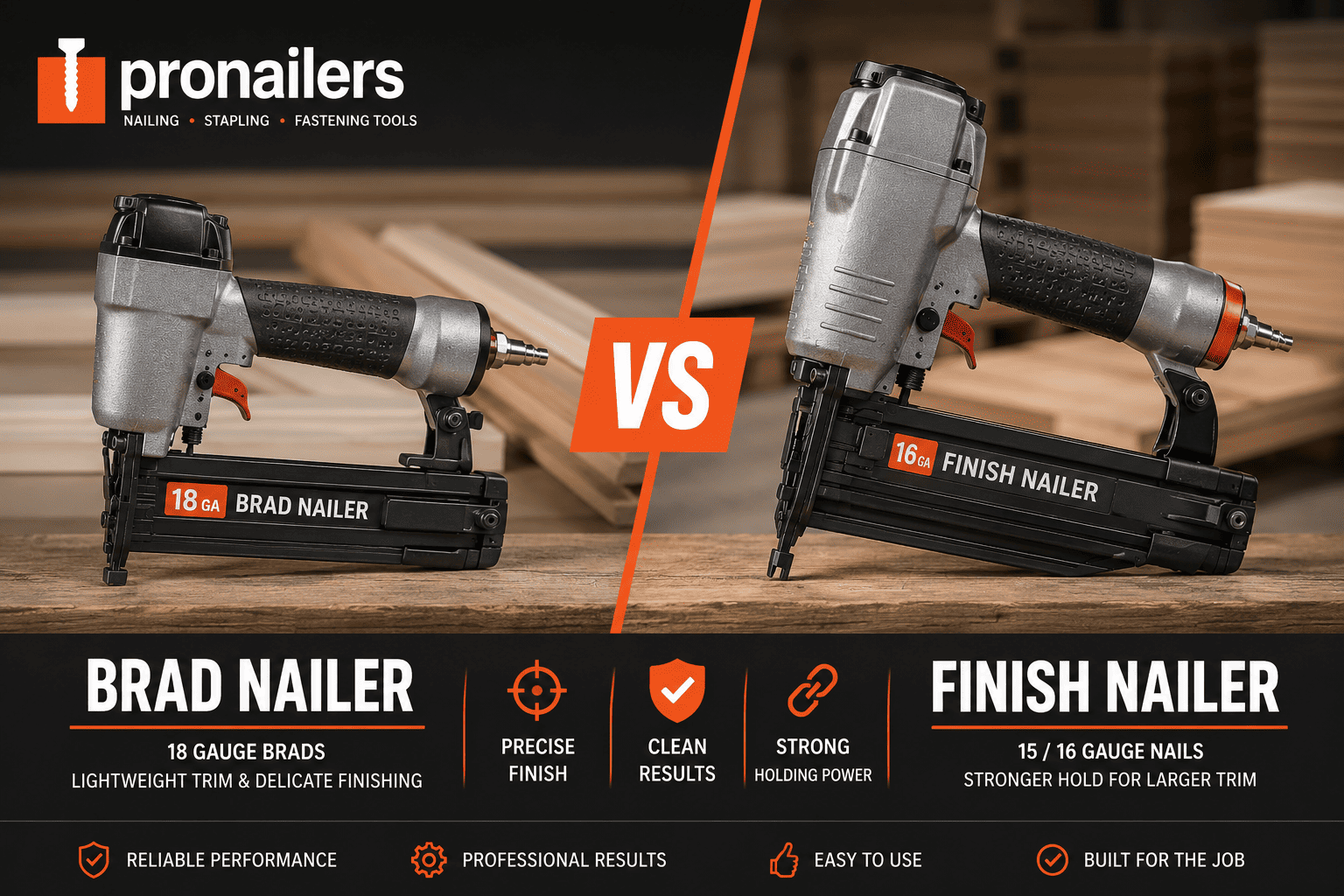
Brad nailers use 18 gauge brads for lightweight trim and delicate finishing, while finish nailers drive 15 or 16 gauge nails for greater holding strength.
-
The right tool depends on the material, trim size, required holding power and the compatible fastener, not simply personal preference.
-
Pneumatic and cordless models are available for both tool types, with each offering advantages depending on the working environment.
-
Selecting the correct nailer and compatible fasteners helps achieve a secure fixing, minimise surface damage and improve the overall quality of the finished installation.
Brad nailers and finish nailers are among the most commonly compared fastening tools because they are both designed for trim and finishing work and often appear similar at first glance. However, they are engineered for different fastening applications and use different types of collated fasteners. Choosing between them is not simply a matter of preference. The gauge, holding strength and intended application all influence how securely the material is fixed and how clean the finished result will look.
The short answer is simple. A brad nailer drives 18 gauge brads that leave smaller holes and are best suited to lightweight trim, decorative mouldings and other delicate work where minimising surface damage is important. A finish nailer uses stronger 15 or 16 gauge finish nails, providing greater holding power for larger mouldings, skirting boards, architraves and other heavier joinery components. Understanding these differences makes it much easier to select the right tool and fastener combination for each project.
Brad Nailer vs Finish Nailer at a Glance
Although both tools are designed for second fix woodworking and joinery, they are intended for different fastening requirements. The main distinction lies in the fasteners they drive. Brad nailers prioritise a clean, discreet finish with minimal surface marking, while finish nailers provide the additional holding strength needed for larger and heavier trim components.
|
Feature |
Brad Nailer |
Finish Nailer |
|
Fastener |
18 Gauge Brad |
15 or 16 Gauge Finish Nail |
|
Typical Fastener Length |
Approximately 15 to 50 mm |
Approximately 25 to 64 mm |
|
Holding Strength |
Lower |
Higher |
|
Hole Size |
Smaller |
Larger |
|
Risk of Splitting Timber |
Lower |
Higher, particularly on narrow mouldings |
|
Best Suited For |
Fine trim and delicate finishing |
Larger trim and heavier finishing work |
|
Common Materials |
Softwood, MDF and lightweight mouldings |
Softwood, hardwood, MDF and larger timber sections |
|
Typical Applications |
Beading, decorative trim, furniture and glazing beads |
Skirting boards, architraves, door casings and cabinetry |
|
Available Tool Types |
Pneumatic and cordless |
Pneumatic and cordless |
In simple terms, a brad nailer is the better choice when appearance is the priority and minimal repair work is desired after installation. A finish nailer is more suitable where greater holding power is needed to secure heavier materials that may be subject to movement or additional load.
What Is a Brad Nailer?
A brad nailer is a fastening tool designed to drive 18 gauge brads into timber, MDF and similar finishing materials. Because these fasteners have a very small diameter, they leave discreet entry holes that often require little or no filling before painting or finishing. This makes the tool particularly well suited to detailed joinery where maintaining a clean appearance is just as important as achieving a secure fixing.
Brad nailers are commonly used for lightweight finishing tasks where larger fasteners could split narrow mouldings or leave unnecessarily visible holes. They provide enough holding power for many decorative components while reducing the risk of damaging delicate materials. In many applications, the brads simply hold the workpiece in position while construction adhesive cures, rather than acting as the primary structural fixing.
Typical Applications for a Brad Nailer
Brad nailers are commonly used for:
-
Beading
-
Decorative mouldings
-
Panel mouldings
-
Furniture assembly
-
Glazing beads
-
Picture frames
-
Lightweight trim
-
Holding small components in place while adhesive cures
Advantages and Limitations of Brad Nailers
One of the greatest advantages of a brad nailer is the clean finish it produces. The slim profile of an 18 gauge brad leaves very little evidence of fastening, reducing the amount of filling and sanding required before decorating. This makes the tool especially popular for painted joinery, decorative mouldings and precision finishing work where appearance is important.
Another benefit is the reduced likelihood of splitting narrow or delicate timber sections. Because the fasteners are much thinner than finish nails, they place less stress on the material during installation, allowing small mouldings and fine trim to be secured with greater confidence.
However, the smaller diameter of the brad also limits its holding strength. Brad nailers are not intended for securing heavy timber components or large trim profiles that require substantial mechanical support. Attempting to use a brad nailer in these situations may result in insufficient holding power, particularly if the material is exposed to vibration, movement or weight over time. Selecting a brad nailer is therefore most appropriate when a neat appearance and minimal material damage are more important than maximum fastening strength.
What Is a Finish Nailer?
A finish nailer is designed to drive 15 or 16 gauge finish nails, which are thicker than brads and provide considerably greater holding strength. These tools are intended for larger finishing applications where the fastener must securely fix heavier timber components while still producing a professional appearance suitable for visible interior joinery.
The increased diameter of finish nails allows them to resist withdrawal more effectively than brads, making them suitable for trim that experiences greater stress or carries more weight. Although they leave larger holes that normally require filling before decoration, the improved holding performance makes finish nailers the preferred choice for many permanent finishing installations.
Typical Applications for a Finish Nailer
Finish nailers are commonly used for:
-
Skirting boards
-
Architraves
-
Door casings
-
Window casings
-
Crown moulding
-
Stair parts
-
Cabinetry
-
Heavier trim and interior joinery
Advantages and Limitations of Finish Nailers
The primary advantage of a finish nailer is its superior holding power. The thicker 15 and 16 gauge finish nails provide a much stronger mechanical connection than brads, allowing larger mouldings, door frames and heavier joinery components to remain securely fixed over time. This makes finish nailers suitable for applications where strength is just as important as appearance.
Finish nailers are also highly versatile. They can be used across a broad range of interior finishing projects, from fitting skirting boards and architraves to installing cabinetry, stair components and substantial decorative mouldings. Many models are available in both straight and angled configurations, allowing easier access when working in confined spaces or awkward corners.
The increased fastening strength does, however, come with some trade-offs. Finish nails leave more noticeable holes that generally require filling before painting or staining. Their larger diameter also increases the possibility of splitting narrow or fragile mouldings if an unsuitable fastener length or placement is chosen. For this reason, finish nailers are best reserved for applications where greater holding strength outweighs the need for the smallest possible fixing marks.
Brad Nails vs Finish Nails
Although brad nailers and finish nailers appear similar, the fasteners they use are designed for different purposes. The most obvious difference is the gauge of the fastener. Brad nailers use 18 gauge brads, while finish nailers are designed for thicker 15 or 16 gauge finish nails. As the gauge number becomes lower, the fastener diameter increases, resulting in greater holding strength.
Brad nails have a very small head and slim shank, making them far less visible once driven into the material. This is ideal for decorative joinery where the finished appearance is important. Finish nails have a larger shank and a more pronounced head, allowing them to grip timber more securely, although they leave a slightly larger hole that normally requires filling before painting or staining.
Both fastener types are available in a range of lengths, allowing them to be matched to different material thicknesses. However, compatibility is determined not only by length but also by gauge. A finish nail cannot be used in a brad nailer, and a brad cannot be used in a finish nailer, as each tool is engineered to feed and drive a specific fastener profile.
|
Feature |
Brad Nails |
Finish Nails |
|
Gauge |
18 Gauge |
15 or 16 Gauge |
|
Diameter |
Thinner |
Thicker |
|
Head Size |
Smaller |
Larger |
|
Holding Strength |
Lower |
Higher |
|
Hole Visibility |
Minimal |
More noticeable |
|
Typical Lengths |
Approximately 15 to 50 mm |
Approximately 25 to 64 mm |
|
Tool Compatibility |
Brad Nailers Only |
Finish Nailers Only |

Holding Strength Explained
Holding strength depends on several factors, but fastener diameter is one of the most significant. Because 15 and 16 gauge finish nails have a thicker shank than 18 gauge brads, they create greater contact with the surrounding timber. This increases resistance to withdrawal and allows them to support heavier trim and larger joinery components more effectively.
Brad nails are intentionally designed to minimise surface damage rather than maximise strength. Their smaller diameter means they can be pulled from the timber more easily, particularly if the material is subjected to movement, vibration or continuous load. For this reason, brads are often used on lightweight decorative pieces or alongside adhesive rather than as the primary structural fixing.
The type of timber also influences performance. Softwood generally provides less resistance than hardwood, while dense hardwood often benefits from the additional strength of finish nails. Likewise, the weight and size of the trim should always be considered. Larger mouldings and solid timber components usually require the stronger holding power provided by a finish nailer.
Which Tool Should You Choose for Different Applications?
Selecting the right tool is largely determined by the size, weight and purpose of the material being installed. Lightweight decorative trim generally benefits from the cleaner finish produced by a brad nailer, while larger architectural mouldings require the additional holding strength of a finish nailer.
|
Application |
Recommended Tool |
|
Decorative Trim |
Brad Nailer |
|
Beading |
Brad Nailer |
|
Quarter Round |
Brad Nailer |
|
Furniture Assembly |
Brad Nailer |
|
Cabinet Installation |
Finish Nailer |
|
Skirting Boards |
Finish Nailer |
|
Architraves |
Finish Nailer |
|
Crown Moulding |
Finish Nailer |
|
Door Casings |
Finish Nailer |
|
Stair Components |
Finish Nailer |
As a general rule, choose a brad nailer whenever preserving the appearance of delicate trim is the priority and the fastener is not expected to carry significant load. Choose a finish nailer when installing larger joinery components that require a stronger mechanical fixing. If a project includes both fine decorative mouldings and heavier trim, many professionals keep both tools available, using each where its particular strengths deliver the best result.
ProNailers Comment: Application tables provide a useful starting point, but trim thickness, material density and the condition of the substrate should also be considered. Where possible, test the selected fastener on an offcut before beginning the main installation, particularly when working with delicate mouldings or dense timber.
Can a Brad Nailer Replace a Finish Nailer?
In certain situations, a brad nailer can be used instead of a finish nailer, but only when the application does not require high holding strength. The suitability depends on the size and weight of the trim, the type of timber and whether the fasteners are expected to provide the primary fixing.
A brad nailer can be used for:
-
Decorative mouldings
-
Beading
-
Picture frames
-
Lightweight trim
-
Holding components in place while construction adhesive cures
A brad nailer should generally not be used for:
-
Skirting boards
-
Architraves
-
Door and window casings
-
Large timber mouldings
-
Applications where the fastener alone must provide long-term holding strength
Can a Finish Nailer Replace a Brad Nailer?
A finish nailer can often complete jobs normally associated with a brad nailer, particularly when working with solid timber or medium-sized trim. However, the larger fasteners are not always appropriate for delicate finishing work where preserving the appearance of the material is a priority.
A finish nailer is suitable for:
-
Medium-sized mouldings
-
Solid timber trim
-
Cabinet installation
-
Interior joinery requiring greater holding strength
-
Projects where only one fastening tool is available
Potential drawbacks include:
-
Larger holes that usually require filling before finishing
-
Greater risk of splitting narrow mouldings
-
Less suitable for delicate decorative trim
-
More visible fixing marks on natural timber

Choosing Between Pneumatic and Cordless Nailers
Both pneumatic and cordless nailers are available for brad and finish fastening applications. The most suitable option depends on the working environment, available equipment and the type of work being carried out.
When comparing the two systems, the following points should be considered:
-
Pneumatic nailers are generally lighter because they do not carry a battery.
-
Pneumatic models require an air compressor, hose and suitable air fittings.
-
Cordless nailers offer greater freedom of movement by eliminating the air hose.
-
Cordless models are well suited to installation work, finished interiors and locations where a compressor is impractical.
-
Pneumatic nailers are often preferred for prolonged daily use and workshop environments.
-
Cordless nailers reduce setup time and are convenient for mobile applications.
Both systems are capable of delivering excellent results when paired with the correct fasteners. The choice ultimately depends on whether continuous operation with compressed air or maximum portability better suits the intended application.
ProNailers Comment: The power source should be selected according to the complete working setup rather than the tool alone. For pneumatic models, confirm that the compressor can supply the required pressure and airflow, while cordless users should consider battery compatibility, charging time and the expected number of fixings per charge.
Brad and Finish Nailers Available from ProNailers
Whether you are looking for a brad nailer for fine finishing or a finish nailer for heavier trim installation, selecting a tool that matches both your application and compatible fasteners is essential. At ProNailers, we supply a wide range of pneumatic and cordless nailers from leading fastening manufacturers, making it easy to find equipment suited to everything from delicate joinery to demanding interior finishing work.
Omer 14.50 16 Gauge Finish Nailer 20mm-50mm
(The Omer 14.50 16 Gauge Finish Nailer 20mm-50mm is a professional pneumatic finish nailer designed for furniture production, cabinet assembly, doors and windows, skirting boards, panelling and other woodworking and second fix applications. Compatible with 16 gauge finish nails from 20mm to 50mm, it combines reliable holding strength with a compact industrial-grade design. Weighing just 1.45kg, the tool is lightweight and easy to handle during extended periods of use, while the rubber grip provides additional comfort and control. Practical features including adjustable depth of drive and a no-mar tip help achieve accurate fastening while protecting finished surfaces. With a 100-fastener magazine capacity and an operating pressure of 70 to 105 PSI, the Omer 14.50 is well suited to professional workshops and production environments where consistent pneumatic performance and long-term reliability are important).
Senco FinishPro18Mg 18 Gauge Brad Nailer 16mm-50mm 1U2025N
(The Senco FinishPro18Mg 18 Gauge Brad Nailer 16mm-50mm is a professional-grade pneumatic brad nailer built with a lightweight magnesium body for excellent durability and comfortable all-day use. Designed to drive 18 gauge brad nails from 16mm to 50mm, it is ideal for applications including cabinetry, furniture repair, chair rails, baseboards, small trim and craft assembly where a clean finish is essential. Its oil-free motor helps prevent oil transfer onto finished surfaces, while features such as dual firing modes, adjustable rear exhaust, rotating belt hook and reload indicator improve productivity on site. Weighing just 1.1kg, the FinishPro18Mg combines precise fastening with low user fatigue, making it a reliable choice for detailed second fix and interior finishing work).
Montana GB16-64-A1/CE 16 Gauge Cordless Gas Finish Nailer 25mm-64mm
(The Montana GB16-64-A1/CE 16 Gauge Cordless Gas Finish Nailer 25mm-64mm is a lightweight cordless gas nailer designed for door and window casings, mouldings, cabinetry, furniture assembly, panelling and other interior finishing work. Compatible with 16 gauge finish nails from 25mm to 64mm, it provides the holding strength required for a wide range of second fix applications without the need for an air compressor or hose. Its slim nose helps reach confined areas, while dial-adjustable depth control and a no-mark tip support accurate fastening and help protect finished surfaces. Weighing 1.8kg, the nailer also features sequential firing, a quick side-loading system and belt holder. Supplied with two rechargeable Ni-MH batteries, a mains charger and plastic carry case, it offers a practical portable solution for installers and finishing professionals working across different locations).
Senco F-15 18V 15 Gauge 34 Degree Cordless Battery Fusion Finish Nailer 32mm-64mm
(The Senco F-15 18V 15 Gauge 34 Degree Cordless Battery Fusion Finish Nailer 32mm-64mm is a high-performance cordless finish nailer that combines Senco's Fusion Technology with the power typically associated with pneumatic tools. Designed to drive 15 gauge DA finish nails from 32mm to 64mm, it is ideal for demanding second fix applications including baseboards, cabinets, chair rails, decorative trim, door and window casings, furniture trim and panelling. Its 34-degree angled magazine provides improved access when working in tighter spaces, while the 18V Li-ion battery delivers consistent performance without the need for a compressor or air hose. Dual firing modes, thumbwheel depth adjustment, an integrated LED work light and the EZ-clear jam release system further enhance efficiency, making this model an excellent choice for professional finishing and installation work).
Paslode IM50 F18 18 Gauge Cordless Fine Finish Brad Nailer 16mm-50mm
(The Paslode IM50 F18 18 Gauge Cordless Fine Finish Brad Nailer 16mm-50mm is a cordless gas-powered brad nailer designed for precision finishing applications including skirting boards, cabinetry, furniture trim, glazing beads, beading, panelling and shop fitting. Compatible with 18 gauge straight brads from 16mm to 50mm, it combines fine fastening with cordless mobility, eliminating the need for a compressor and air hose. Its lithium battery delivers up to 10,000 shots per full charge, while a fuel cell provides approximately 1,000 shots. Tool-free depth adjustment, a no-mar tip and clear line of sight help achieve accurate, consistent results on finished surfaces, while improved balance makes the tool easier to manoeuvre in confined areas. The IM50 F18 also features a reversible belt hook and easy jam clearance and is supplied with a lithium battery, charger and high-impact carry case).
The products featured above represent just a small selection of the brad nailers and finish nailers available from ProNailers. Our range also includes compatible collated brads and finish nails, air compressors, pneumatic components and accessories, allowing you to source a complete fastening solution for virtually any woodworking, joinery or second fix application from a single supplier.Key Features Worth Considering Before Buying
While fastener compatibility should always be the primary consideration, several additional features can improve accuracy, efficiency and ease of use. These do not change the type of work a nailer is designed for, but they can make day-to-day operation more convenient and help achieve more consistent results.
When comparing brad and finish nailers, look for the following features:
-
Depth adjustment allows the driving depth to be fine-tuned for different timber species and material thicknesses without changing the air pressure or power settings.
-
No-mar tip helps protect painted, finished and delicate surfaces from scratches or dent marks during installation.
-
Magazine capacity determines how many fasteners the tool can hold before reloading. A larger capacity can reduce interruptions during repetitive work.
-
Tool-free jam clearing makes it quicker to remove jammed fasteners, reducing downtime on site.
-
Dry-fire lockout prevents the tool from firing when the magazine is almost empty, helping protect both the workpiece and internal components.
-
Selectable firing modes allow users to switch between sequential firing for greater control and contact firing where faster repetitive fastening is appropriate.
-
Adjustable exhaust redirects exhaust air away from the operator and the work surface, improving comfort and helping keep dust away from the installation area.
Selecting a nailer with the right combination of these features can improve productivity while making the tool easier and more comfortable to use across a wide range of finishing applications.
Safety Tips When Using Brad and Finish Nailers
Brad and finish nailers should always be operated in accordance with the manufacturer's instructions and appropriate safety procedures. Even when working with relatively small fasteners, these tools are capable of causing serious injury if used incorrectly.
Good practice includes:
-
Wearing suitable eye protection to guard against flying debris and wood fragments.
-
Using hearing protection, particularly when operating pneumatic tools for extended periods.
-
Keeping hands and fingers clear of the firing area at all times.
-
Using sequential firing mode whenever maximum control and accurate fastener placement are required.
-
Loading only the fastener type, gauge and length specified for the particular nailer.
Following these basic precautions helps reduce the risk of accidents while ensuring the tool operates safely and reliably.
Conclusion
Neither a brad nailer nor a finish nailer is inherently better than the other. The right choice depends on the specific application, including the weight of the trim, the level of holding strength required, the material being fixed and the size of the fastener needed for reliable performance. Selecting the correct combination of tool and fastener helps achieve a secure installation while maintaining the desired finish quality.
At ProNailers, we supply a comprehensive range of pneumatic and cordless brad nailers, finish nailers and compatible collated fasteners for a wide variety of woodworking, joinery and interior finishing applications. Whether you are replacing an existing tool or selecting equipment for a new project, choosing the correct fastening system will help improve efficiency while delivering a high-quality finished result.
Frequently Asked Questions About Brad Nailers and Finish Nailers
Is a brad nailer better than a finish nailer?
Neither tool is better in every situation. A brad nailer is designed for lightweight trim and delicate woodworking where a smaller fastener and minimal surface marking are important. A finish nailer is better suited to heavier trim and joinery that requires greater holding strength. Choosing the correct tool depends on the application rather than the tool itself.
Can I use 18 gauge brads instead of 16 gauge finish nails?
Only if the application requires relatively little holding power. Eighteen gauge brads are thinner and create smaller holes, but they also provide less resistance to pull-out. For skirting boards, door casings and other heavier trim, 16 gauge finish nails generally provide a more secure fixing. The fasteners are not interchangeable because each tool is designed for a specific gauge.
Which tool leaves the smallest visible nail holes?
A brad nailer typically leaves the least noticeable holes because it drives 18 gauge brads with a very small head. In many finishing applications, the holes require little or no filling before painting. Finish nails produce larger holes that are more visible but remain easy to conceal with wood filler when necessary.
Can a finish nailer split delicate timber?
It can, particularly when working with narrow mouldings, thin hardwoods or fragile decorative trim. The thicker 15 or 16 gauge fasteners apply greater force and may increase the likelihood of splitting near edges or ends. In these situations, an 18 gauge brad nailer is often the safer choice. Selecting the correct fastener length is equally important for reducing the risk of damage.
Are pneumatic and cordless nailers equally capable?
Both types are capable of producing high quality results when matched to the appropriate application. Pneumatic nailers are generally lighter and are well suited to continuous workshop or site use where an air compressor is available. Cordless models offer greater mobility and faster setup because they do not require an air hose. The best option depends on your working environment rather than fastening performance alone.
How do I choose the correct fastener length?
The fastener should be long enough to penetrate the base material securely without passing completely through it. As a general guide, the nail should enter the substrate by a sufficient depth to provide reliable holding strength while remaining compatible with the material being fixed. Timber density, trim thickness and the weight of the workpiece should all be considered when selecting the appropriate length.
Can one tool handle all interior trim work?
In most cases, no. Brad nailers and finish nailers are designed for different tasks and complement one another rather than replace each other. A brad nailer is ideal for lightweight decorative mouldings and fine trim, while a finish nailer is intended for larger interior joinery that requires stronger holding power. Many professionals keep both tools available to cover the full range of finishing applications.
Do brad nailers and finish nailers use the same magazine?
No. Each tool is engineered to feed a specific fastener gauge and profile, so the magazines are not compatible. Attempting to load the wrong type of fastener can cause feeding problems, jams or damage to the tool. Always use the fastener type and size specified by the manufacturer for the particular nailer.